
How to Store Christmas String Lights Without Tangling Them
SEO Team ·
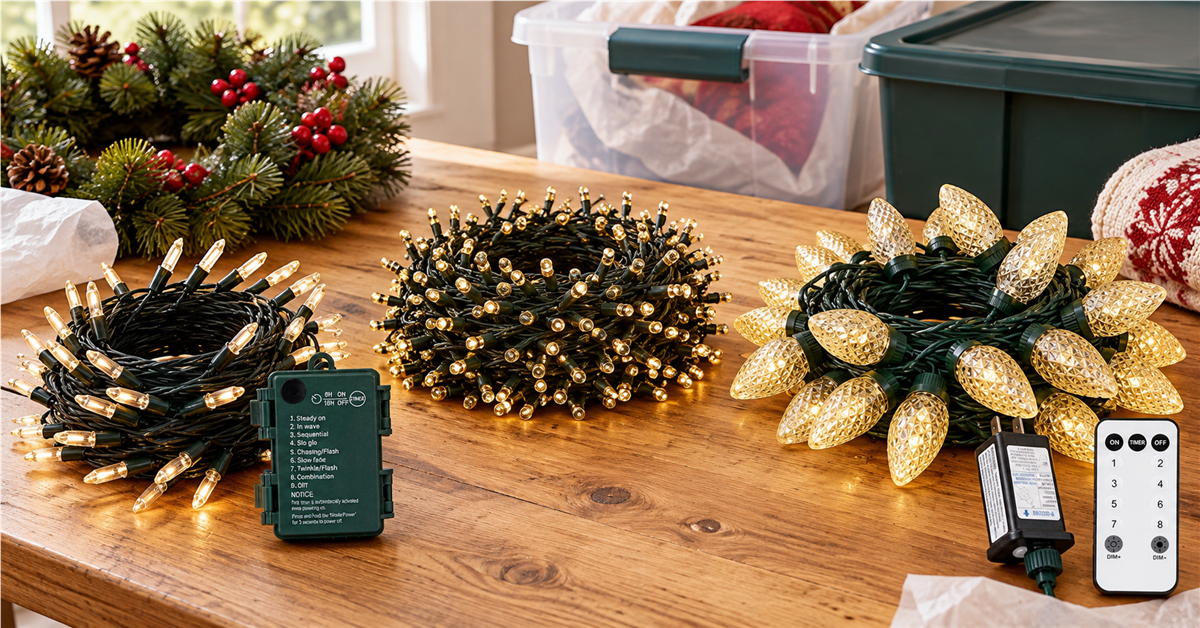
Learning how to store Christmas string lights starts with treating each light style separately. Mini battery lights, dense cluster lights, and larger C9 bulbs have different shapes and controllers, so one tight bundle can tangle fine wire or press against the bulbs. A careful post-season routine keeps each strand identifiable and makes the next setup easier.
Unplug and inspect before packing
Switch the lights off and disconnect them from power before handling. For a battery-powered string, remove or disconnect the battery box according to the product instructions. Let any outdoor-rated set dry fully after use before it goes into storage. Check the wire, plug, controller, battery box, and bulbs for damage, loose parts, discoloration, or moisture. Set aside a strand that appears damaged instead of packing it away for next season.
Do not pull a string by its wire or force a tight knot open. Work from the plug or controller end and loosen tangles gently on a clear table. If a product’s instructions specify a different storage method, follow those directions.
Make a loose coil for each light type
For mini lights, wind the wire in broad loops around a smooth piece of cardboard or a reusable reel. Keep the loops loose enough that the wire does not kink. Place the battery box beside the coil rather than wrapping wire tightly around it. The 18-foot battery-operated ISEEBIZ string has a separate control box, so leave that part accessible and avoid putting pressure on its buttons or cover.
Dense cluster lights have many short branches close together. Gather them in loose sections instead of compressing the whole strand into a small ball. For the 25-foot, 500-LED cluster set, a wide reel or shallow container can help keep loops from bearing down on one another.
C9 lights have larger faceted bulbs. Arrange them in a broad circle or on a reel so bulbs are not pressed face-to-face. Keep the plug, remote, and controller with the strand but in a protected position. The 81-foot C9 string should be stored according to its own product guidance; do not force the bulbs into a smaller container.
Separate controls and label both ends
Put each strand in its own bag or compartment so C9 bulbs cannot press against mini lights. Keep the matching controller, remote, clips, and product instructions with that strand. Add a simple label with the length, light type, color, intended location, and whether it was tested before storage. A note such as “front porch” or “tree” is more useful next season than opening every box to identify a set.
For remote-controlled lights, protect buttons from pressure and store the remote in a small marked pouch. For battery-operated lights, keep batteries out of a sealed box if the manufacturer advises removing them. Never mix loose batteries with metal objects.
Choose a dry, protected storage place
Store the packed lights indoors in a dry spot away from standing water, crushing weight, and sharp tools. Keep bins off a damp floor and do not place heavy seasonal decorations on top of delicate bulbs. Avoid wrapping the strands around objects with sharp edges, which can stress the wire over time.
Before the next installation, unpack one set at a time and inspect it again. Test the strand on the ground before placing it on a tree, porch, or roofline. Our separate guides explain how to test outdoor lights before hanging, how to plan timer settings, and how to plan C9 lights for a roofline.
Quick storage checklist
- Power is disconnected and the strand is dry.
- Wires and bulbs have been inspected for damage.
- Each style has a separate loose coil.
- Controllers, remotes, and battery boxes are protected and labeled.
- The bin is stored in a dry place without weight pressing on bulbs.
Frequently asked questions
Can I store different Christmas lights in one bin?
They can share a larger bin only if each strand is separately coiled and protected. Separate compartments help keep large C9 bulbs from pressing against smaller lights.
Should I test lights before storing them?
It is useful to note whether a strand worked, but disconnect it before packing. Test it again on the ground before the next installation.
Loose, separate coils and clear labels take a little more time today, but they prevent a tangled first setup and make it easier to find the right string next season.